Old city
The Gothic Quarter
The Barri Gòtic is two places stacked on top of each other: a genuinely ancient Roman town, and a beautiful early-1900s idea of what a medieval town should look like. Knowing which is which makes the walk far more interesting.
Most people wander in from La Rambla, get swallowed by the lanes, photograph a stone bridge, and leave convinced they've walked through the Middle Ages. Some of it is exactly that old. A surprising amount is barely a hundred years old and was designed to look medieval on purpose. Neither fact ruins the place; it changes what you're looking at.
Here's the honest version, square by square.
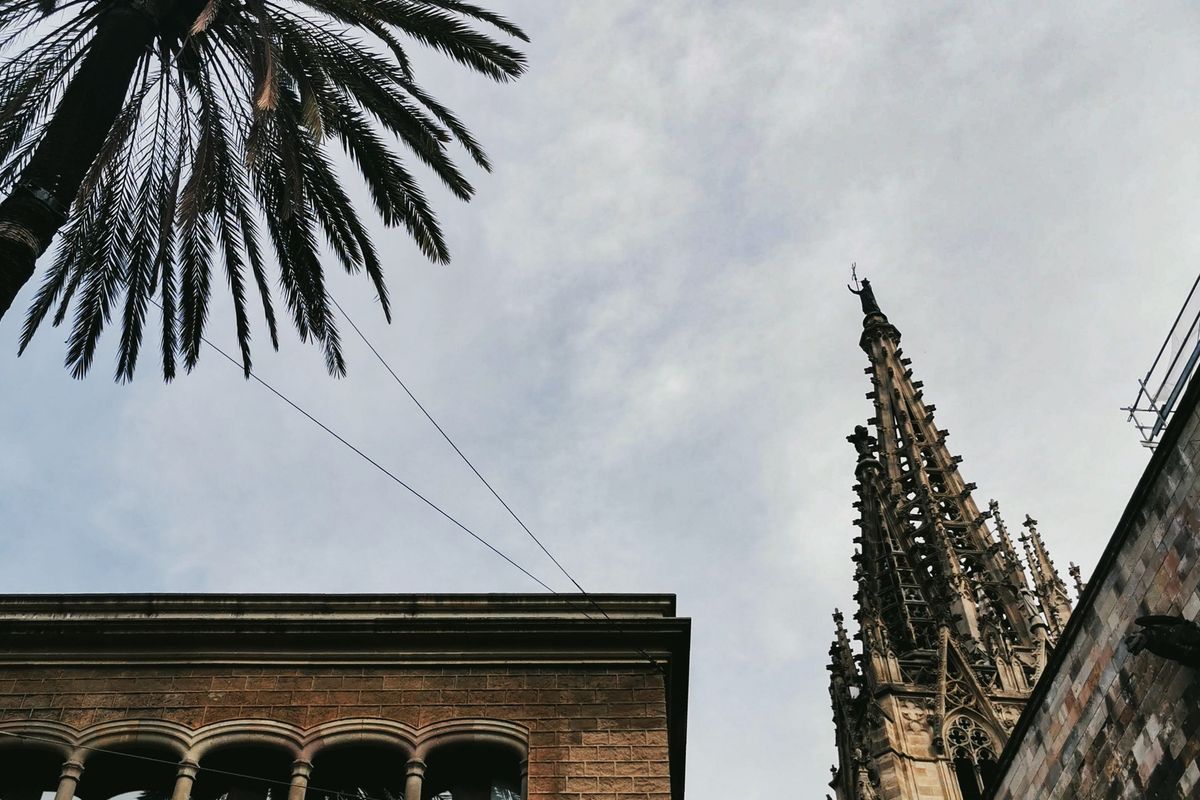
The cathedral, the cloister, and thirteen extremely confident geese
Start at the cathedral — La Seu, properly the Cathedral of the Holy Cross and Saint Eulàlia. The Gothic body was finished around 1448, and that part is the real thing. The dramatic front facade is not: that gargoyle-crusted front was added between 1887 and 1890, draped over a much plainer Catalan exterior. So the most photographed face of the cathedral is younger than the building behind it. Still magnificent. Just younger than it dresses.
Go inside and find the cloister, the bit people skip and shouldn't. It wraps a small garden where thirteen white geese live full-time, honking with the authority of birds who know exactly why they're there. The number isn't random: Eulàlia, the city's co-patron, is said to have been thirteen when she was martyred, and the geese have served as her feathered honour guard for centuries. In the corner stands the Font de les Oques, the Well of the Geese; on certain feast days an egg is set to dance on the jet of the fountain. Gloriously strange.
The geese are not a gimmick added last decade. They predate every guidebook in your bag, and they will outlast this one too.
If your knees are willing, take the lift to the roof. A few euros buys the spires up close and a flat-roofed view across the old town you can't get from street level — quieter than the queue downstairs suggests.
Plaça del Rei — where the actually ancient city is hiding
A few minutes east, Plaça del Rei is a tight medieval courtyard ringed by royal buildings, and it's one of the most genuinely old-feeling corners of the quarter. The real revelation is underneath it. Below the square runs the Barcelona City History Museum, where a glass walkway carries you about four metres down into Barcino — the Roman colony that became Barcelona.
This isn't a few sad bricks behind rope. You walk through whole streets: a laundry and dye works, a winery with the vats still in place, fish-salting basins, and later an early Christian episcopal complex stacked on top. Rome, then the Visigoths, then the medieval city, one floor over the next. The ruins surfaced during 1930s building works and have been open since the 1940s. If you pay to enter one thing in the Barri Gòtic, choose this. The street above is a film set; the street below is the original.
Four Roman columns in a courtyard most people walk straight past
Now my favourite quiet trick here. On Carrer del Paradís, at number 10, an ordinary doorway has a millstone set into the threshold marking the highest point of the old Roman town, Mont Tàber. Step into the courtyard: four enormous Corinthian columns rise the full height of the building — the surviving corner of the Temple of Augustus, roughly two thousand years old, now hemmed in by a hiking club. Entry is free.
You can stand a hand's width from masonry that was already old when the cathedral was a building site, and almost nobody is in there. That contrast with the camera-jam two streets over is the whole point of this neighbourhood.
While you're tuned to Roman Barcelona, notice the wall. Chunks of the original fortification — first built in the first and second centuries AD, then thickened a couple of hundred years later — sit embedded in the fabric of the quarter, medieval houses grown straight onto them like ivy. Spot the first stretch and you'll see it everywhere.
Sant Felip Neri — the saddest, quietest square in the city
Tuck into Plaça de Sant Felip Neri and the noise drops away. A baroque church, a plane tree, a fountain, children's voices. Then you see the pockmarks gouged across the wall and the story turns hard.
In January 1938, during the Civil War, a bomb dropped by Franco's aircraft fell here. Many of the dead were children sheltering in the church; a second blast caught the people who rushed in to help, and the toll reached the forties. The scars are shrapnel marks, left unrepaired as a memorial. For decades a misleading sign blamed firing squads — it was the bombing, and the city's memory programme sets the record straight. Stand a minute, then walk on gently.
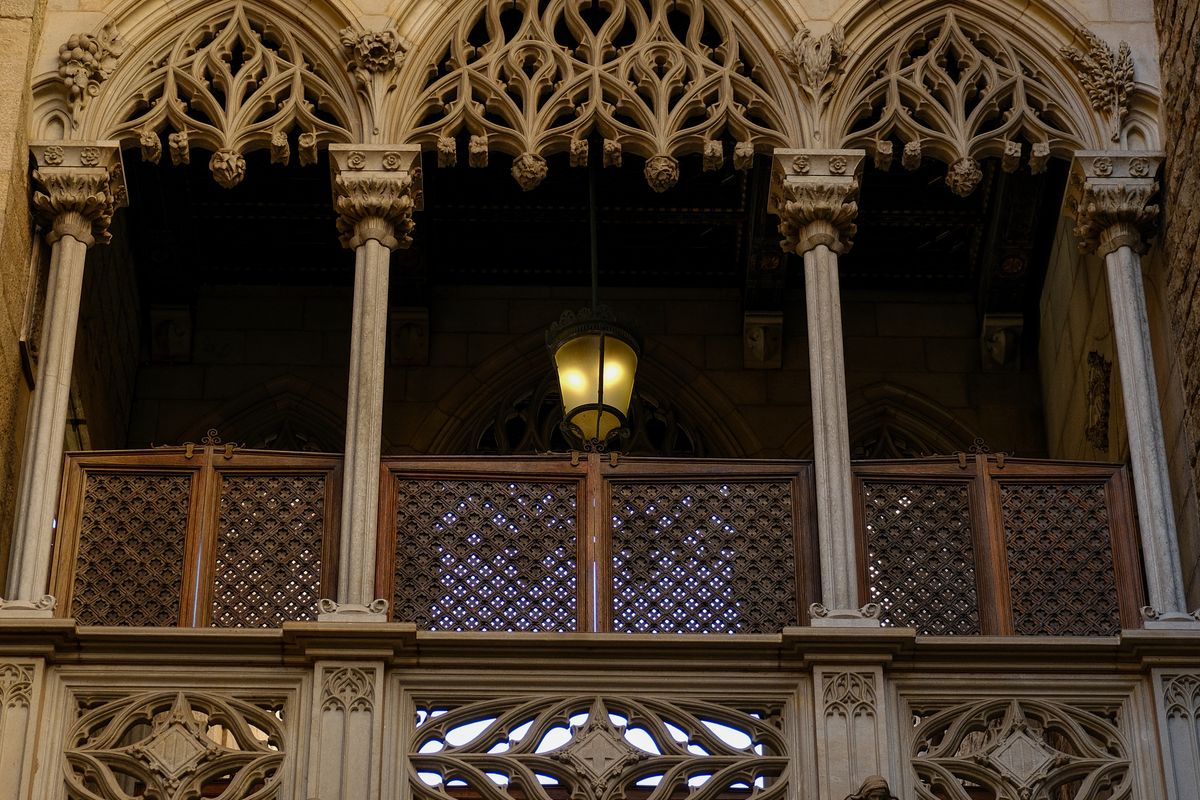
The famous bridge that fooled you, and the lampposts that didn't
Back to that bridge. The Pont del Bisbe — the covered neo-Gothic skywalk over Carrer del Bisbe, with its delicate tracery and, if you look up, a small skull pierced by a dagger — is the single most photographed "medieval" thing in the quarter. It went up in 1928. The architect, Joan Rubió i Bellver, was a disciple of Gaudí, and the bridge is the only piece ever realised of a much bigger scheme to flatten the non-Gothic buildings around the cathedral and rebuild the area in romantic medieval style for the 1929 World's Fair. So much of the "Gothic look" the quarter is named for is theatre from under a century ago. The bridge is lovely. It is also a prop.
Compare that with two squares nearby:
- Plaça Reial — a porticoed, palm-shaded square off La Rambla, with a central fountain and two ornate lampposts that were Gaudí's first paid public commission. Buzzy, a bit touristy, genuinely pretty at dusk.
- El Call — the old Jewish quarter, a knot of some of the narrowest lanes in the whole district, with fragments of a medieval synagogue. Easy to miss, worth seeking out, far more lived-in than its history suggests.
None of this makes the quarter fake. Read it right and it's a palimpsest: real Roman stone, real medieval bones, a beautiful early-twentieth-century gloss over the top. For the city beyond these walls, our notes on La Rambla and the Boqueria and on neighbouring El Born and the Picasso Museum pick up where this walk ends.
Walking it without losing your wallet or your mind
The quarter is small, walkable, and built to disorient — part of the fun. Don't navigate. Pick a rough direction and get lost on purpose; you'll surface near the cathedral eventually, because everything bends back toward it.
A few practicalities, learned the dull way:
- Come early. Before about ten in the morning the lanes are calm, the light rakes nicely down the stone, and you can actually photograph the bridge without forty other people in frame.
- Mind your bag, properly. The crowded pinch-points — the bridge, the cathedral steps, the mouth of La Rambla — are textbook pickpocket territory. Front pocket, zip closed, hand resting on it in a crush. Lonely Planet's overview of the area says the same thing in politer words.
- Wear something other than smooth-soled shoes. The old paving is polished glassy by a few million footsteps and turns into a skating rink in the rain.
Short verdict, if you've only got an hour: skip nothing ancient, see through everything that's pretending. The genuinely old marvels sit underground at Plaça del Rei and in that hiking-club courtyard. The Pont del Bisbe and the cathedral's grand face are gorgeous twentieth-century romance — enjoy them as exactly that, and the neighbourhood snaps into focus.