Modernisme
The Eixample & modernisme
Almost everyone treats the Eixample as a corridor between Gaudí stops. It is, in fact, the thing itself — a grid you can read like a diagram, and an open-air museum of Catalan modernisme you keep walking straight past.
Look at a map of central Barcelona and the Eixample (Catalan for "extension") is the part that looks suspiciously tidy: hundreds of near-identical blocks in rows, the streets running on a slight diagonal so the whole thing sits at an angle to the coast. That regularity is not an accident. It was drawn deliberately in the 1850s, when the medieval walls finally came down and the city spilled out into the plain.
The man with the pencil was Ildefons Cerdà, an engineer who liked geometry rather more than the local landowners did. His plan gave each block a footprint of roughly 113 by 113 metres, then cut the four corners off at 45 degrees. The result is what people here call a xamfrà — a chamfer that turns every crossroads into a small octagonal opening. Stand at one and you notice how much sky you suddenly have.
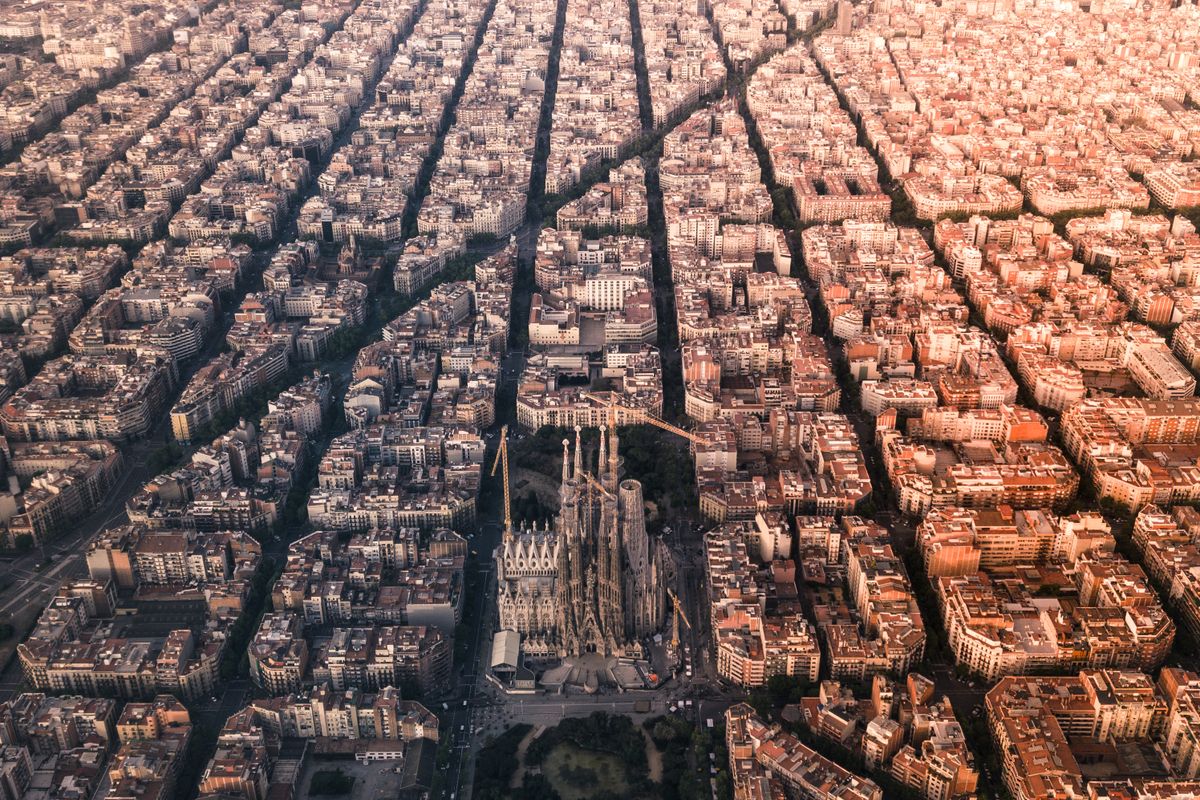
Cerdà's grid, and what got built on top of it
Cerdà wanted light and air for everyone, not just the rich. His blocks were meant to be built up on only two sides, kept low, and wrapped around a green interior courtyard. Speculation had other ideas: developers built on all four sides, went higher than the plan allowed, and filled most of the courtyards with workshops and garages. For decades the green hearts of the blocks were simply lost.
Some have since been clawed back. A number of interior courtyards have reopened as small public gardens — quiet rectangles of bench, tree and fountain reached through an unremarkable doorway, that almost nobody else seems to know about. See an open gate mid-block? Go in. The contrast with the traffic outside is the whole point Cerdà was making, about a century and a half late. And what went up on that grid coincided with the richest patch of Catalan architecture there has ever been: a new bourgeoisie wanting to show off, generous plots, a generation of architects obliging. In effect, the Eixample is modernisme's display cabinet.
Modernisme is not a synonym for Gaudí
It is easy to arrive thinking modernisme means Antoni Gaudí and the queue outside Casa Batlló and La Pedrera. He is the loudest voice, not the only one. Two of his contemporaries did work every bit as worth your morning, and with a fraction of the crowds.
Lluís Domènech i Montaner is the name to learn. He built the Palau de la Música Catalana, a concert hall finished in 1908 for a choral society, where a steel frame let him hang the walls with stained glass and dissolve the room into colour. By day it is lit almost entirely through an inverted glass skylight — there is nowhere quite like it in Europe.
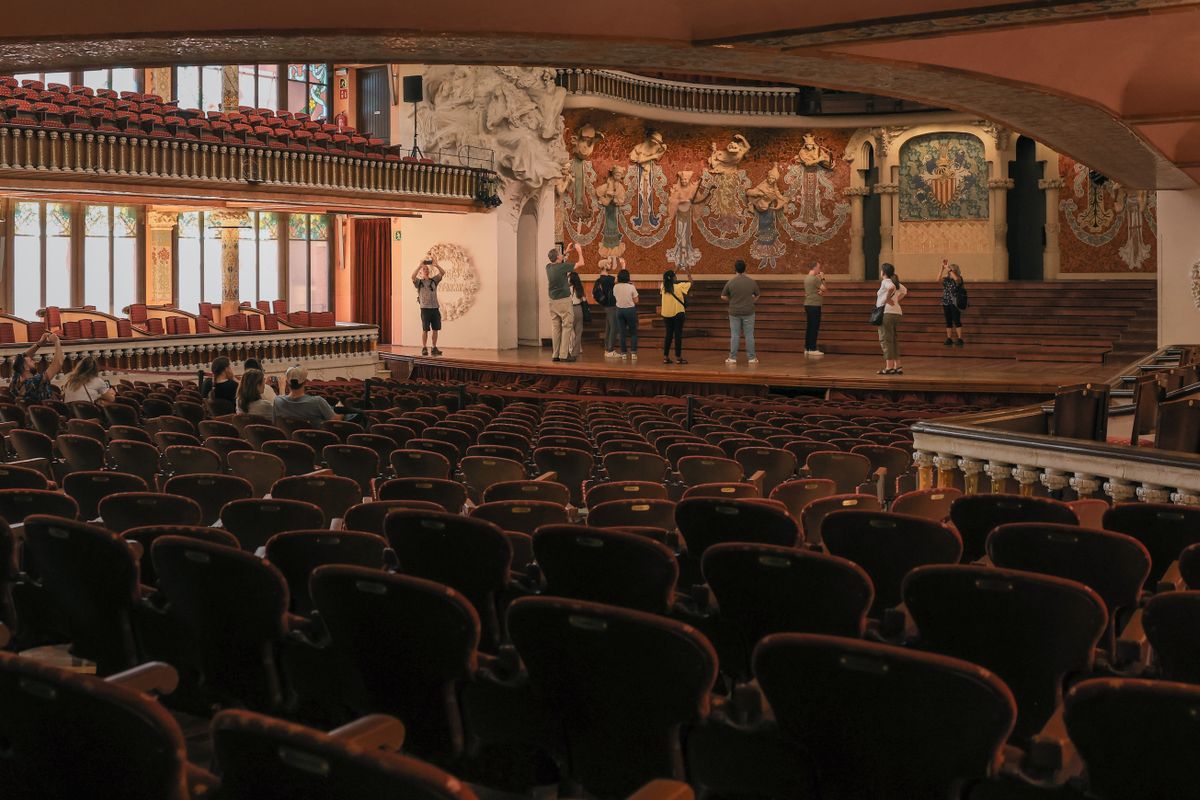
His other masterpiece sits a short walk uphill from the Sagrada Família. Hospital de Sant Pau is a genuine working hospital reimagined as a garden city: a dozen pavilions wrapped in mosaic and sculpture, linked by underground tunnels, set in lawns. Built between 1905 and 1930, it treated patients until 2009 and is now a cultural campus you can walk straight through. Both it and the Palau were inscribed on the UNESCO World Heritage list in 1997.
Most playful of the three was Josep Puig i Cadafalch. His Casa Amatller on Passeig de Gràcia — built for a chocolate magnate around 1900 — has a stepped Flemish gable and sits right next to Gaudí's Casa Batlló, the two practically arguing across the property line. A few blocks north, his Casa de les Punxes ("house of spikes") looks like a small medieval castle that wandered into the wrong century.
The Quadrat d'Or and Passeig de Gràcia
Most of the great houses cluster in a rough rectangle the city markets as the Quadrat d'Or, the "golden square." Its spine is Passeig de Gràcia, the broad boulevard running from Plaça de Catalunya up towards Gràcia: nineteenth-century money came here to build, today's money comes to shop, and it is now the most expensive retail street in Spain. You needn't enter a single shop to enjoy it. Walk slowly, look up, and let the upper storeys do the work — wrought-iron balconies, ceramic panels, the strange paving and lamp-posts Gaudí designed for the avenue itself. The famous "block of discord," three rival modernista houses by three rival architects on one short stretch, is the densest few metres of the whole game.
If you want a thread to follow, buy into the Ruta del Modernisme, the city's self-guided trail. The pack starts at the Centre del Modernisme inside Casa Amatller and comes with discount vouchers for several interiors. Three hours, your own pace, and a built-in excuse to stop for vermouth.
The vermouth hour, and why the grid is good to you
The single best Eixample habit is one locals never gave up: fer el vermut, the weekend ritual of a glass of vermouth before lunch. Neighbourhood bars pour it from the barrel, over ice, with an olive and a slice of orange, and it is meant to be unhurried. Pair it with a small plate, watch the corner, and you have understood more about the district than any guided tour will tell you.
Getting around here is mercifully simple. The grid is dead flat and walkable, the chamfered corners make it hard to get truly lost, and Metro stops sit under the main avenues. One practical reason to base yourself here, beyond the architecture, is connections — it is the part of town best stitched into the rest of the city and to the airport run, which matters more than it sounds when you are jet-lagged. We cover the nuts and bolts in getting around Barcelona.
A few things worth knowing before you go looking:
- Go early for the calm ones. Sant Pau and the Palau rarely jam like the Gaudí houses — though the Palau is best on a guided slot, or at an actual concert.
- Buy timed tickets online. For anything with Gaudí's name on it, the walk-up queue is its own punishment. The Domènech sites are far more forgiving.
- Look for open courtyard gates. The reopened interior gardens are free, half-hidden, and the closest thing the district has to a secret.
- Pace it. Facade-spotting tires you out faster than you'd think. Two or three houses and a long lunch beats a forced march.
The mistake is to treat the Eixample as the dull bit between the famous bits. It is the famous bit — Cerdà drew the most-copied city plan of the modern era, and a whole movement chose to decorate it. You just have to remember to look up while you're crossing the road.
The honest verdict
Here is what I would tell a friend. You will almost certainly sleep, eat and drink in the Eixample whether you plan to or not, so make the district part of the trip rather than scenery you blur past on the way to a ticket queue. Give Gaudí his due — he earned it — but don't let him eat the whole day. Walk the Quadrat d'Or with your chin up, find an open courtyard, do the vermouth, and take the short detour out to Sant Pau and the Palau de la Música. They are calmer, cheaper to enjoy, and on a quiet morning arguably more moving than fighting a crowd.
Before you commit a morning, three places worth checking: the official Sant Pau site for hours and pavilion tours, the Palau de la Música concert programme, and the UNESCO listing for the formal reasons both made the cut.