Gaudí
Park Güell
Half of Park Güell costs money and half of it doesn't. Knowing which half is which is the whole trick to enjoying the place.
Here is the thing nobody tells you on the way up Carmel hill: most of Park Güell is free. The pine woods, the dusty switchback paths, the stone viaducts that lean out of the slope like something grown rather than built — none of that is ticketed. What you pay for is a fenced-off core of about a dozen acres at the bottom of the hill, and inside it sits the postcard: the wavy mosaic bench, the columned hall, the tiled lizard on the stair. That core is small. The hill around it is large. Getting the balance right is the difference between a good morning and a mild disappointment.
Gaudí built the place between 1900 and the start of the First World War, originally as a housing estate for the industrialist Eusebi Güell. The houses never sold. The estate became a public park instead, and the part Gaudí had finished — the entrance, the terrace, the colonnades — is now the bit you queue for.
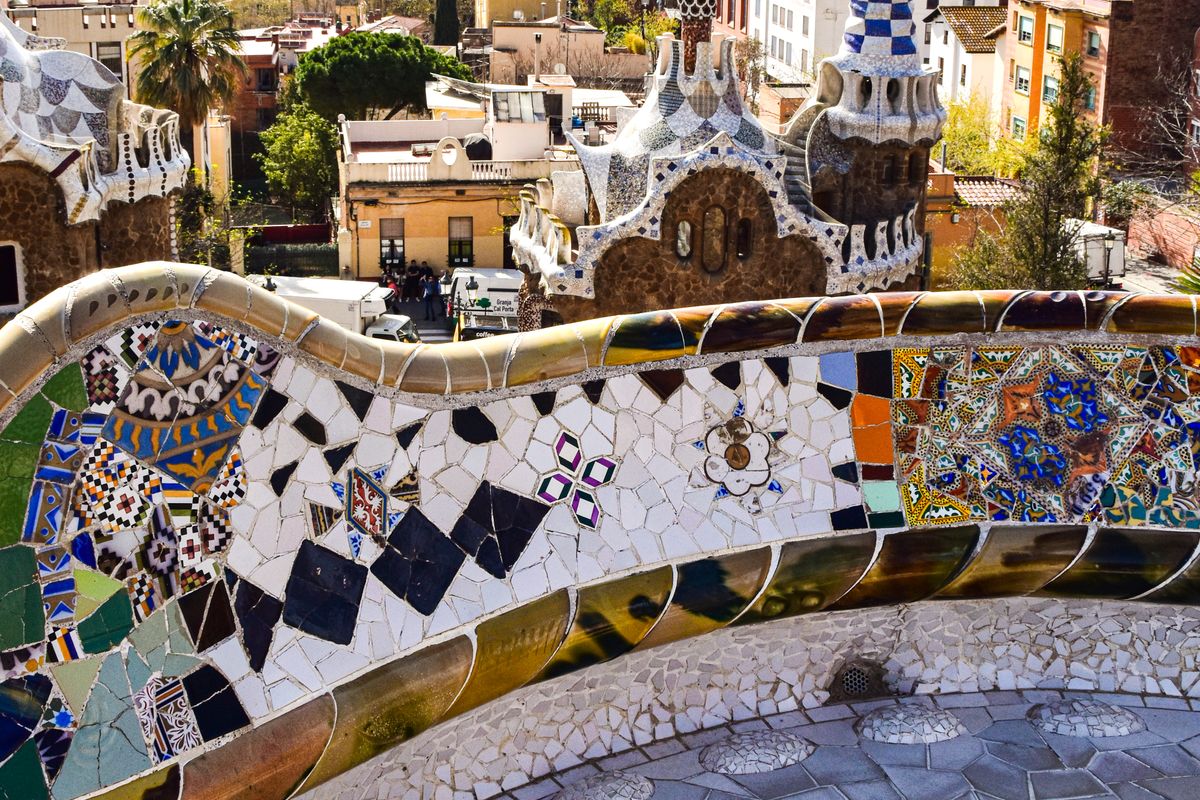
What the ticket actually buys
The paid section is called the Monumental Zone, and it's the concentrated dose of Gaudí. A timed ticket gets you the lot:
- The Nature Square terrace and the serpentine bench that rings it — a 110-metre ribbon of broken-tile mosaic, designed largely by Gaudí's collaborator Josep Maria Jujol, who had a far better eye for colour than he ever got credit for.
- The Hypostyle Hall directly beneath the terrace: eighty-odd Doric columns holding the whole thing up, with little mosaic suns set into the ceiling between them.
- The dragon stair at the main gate, where the tiled salamander — locals call it el drac, the guidebooks hedge and say lizard — splits a double staircase down the middle.
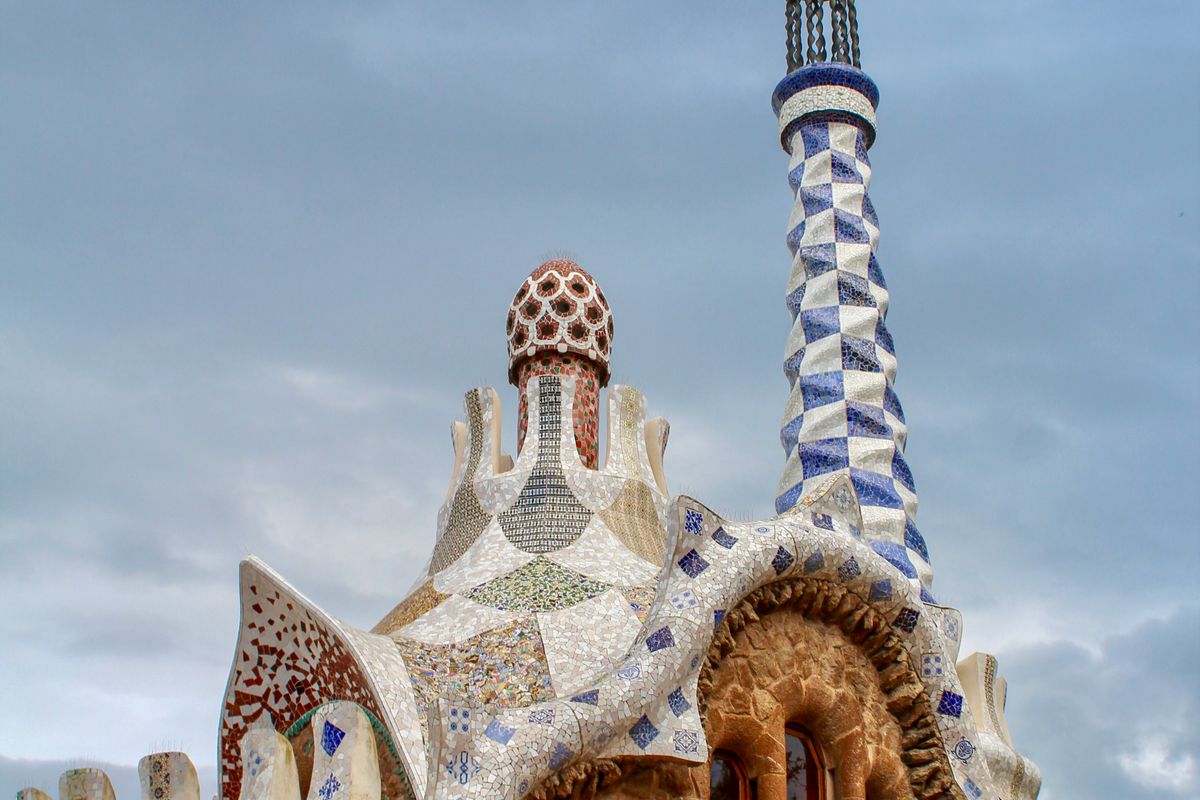
- The two gatehouses flanking the entrance, the ones with roofs like melting gingerbread, one of which now holds a small museum about the park's history.
That's it. Walk it without rushing and you'll spend somewhere around an hour, maybe ninety minutes if the bench is busy and you're waiting for a clear frame. It is genuinely beautiful. It's also genuinely compact, which is worth saying out loud before you've paid.
The mosaic bench was free to sit on for decades. Ticketing only arrived in 2013, and the bench ended up on the wrong side of the fence. So if an old guidebook tells you to wander up and lounge on it for nothing, that guidebook is out of date.
The free park is the bigger park
Step outside the Monumental Zone fence and the rest of the hill opens up at no charge. This is where people who live nearby actually go — walking the dog, jogging the gravel loops, reading on a bench that isn't covered in tourists or tile.
Two things up here are worth the climb on their own. First is the network of stone porticoes and leaning columns that march along the slope; they're rougher and stranger than the polished core, and you'll often have a stretch entirely to yourself. Second is the Turó de les Tres Creus, the Hill of the Three Crosses, the highest point in the park. A plain stone monument marks the top, and a 360-degree view runs from the Sagrada Família's spires across the whole grid of the city to the sea. No ticket, no time slot, no queue. On a clear day it's the best free view in Barcelona, and I'll argue that with anyone.
Getting up there without sweating through your shirt
The park sits on a hill, and there is no station at the gate. Every route involves a climb; the only question is how steep you want it.
Metro is the usual way in. Line 3 (the green one) has two useful stops. Lesseps leaves you a steady ten-to-fifteen-minute walk uphill on pavement. Vallcarca is a touch closer and, better still, connects to a set of public outdoor escalators that carry you most of the way up the slope — a small civic kindness that saves your legs in July. If you'd rather not walk at all, buses 24 and H6 stop near the upper entrance, which deposits you at the top of the park rather than the bottom, handy if you want to walk the free woods first and arrive at the bench going downhill. Routes and live times sit on the city transport authority's site.
Note
Skip the taxi if the meter's been running all day. The road up is narrow, often clogged near the gates, and you'll be dropped a short walk from the entrance anyway. A car makes most sense at the start of the day, straight from where you're staying or the airport — before the crowds and the heat have stacked up. For the wider picture on moving around the city, the getting around Barcelona notes go through every option.
Money, timing, and one small con to avoid
A standard adult ticket runs around €18 at the moment, and the Monumental Zone works on visitor caps with timed entry — you book a slot, you arrive in that slot, you go in. Buy it online before you leave your room. Turning up hoping to walk in on a spring weekend is how people end up staring through the fence at a bench they can't reach, or killing two hours until the next available slot. Prices and the day's opening hours sit on the official park site, which is the only booking page I'd trust; plenty of lookalike resellers pad the price.
Go early. I mean properly early — first or second slot of the morning. By eleven the bench is three rows deep, the terrace bakes, and the queue for the dragon stair photo turns into a slow shuffle. At nine the light is softer, the tiles aren't reflecting heat at your face, and you can actually see the thing you came to see. The park sits inside a stretch of Gaudí's work that earned the city its UNESCO listing, and on a quiet morning you understand why; at midday in August you mostly understand other people's elbows.
So is the paid bit worth it?
Honestly? On its own, the Monumental Zone is a lot of money for not very much ground. If you only care about ticking the bench off, you'll be back out the gate inside an hour wondering where the rest of it went. But framed properly, it's still a yes. Pay for the core, get your photo on the terrace, walk the Hypostyle columns — then spend the back half of your visit in the free park: the porticoes, the woods, the climb to the Three Crosses for that view. One ticket, one wander, two halves of the same hill. Treated that way it's a genuinely good morning rather than an expensive twenty minutes.
And if Gaudí gets under your skin up here — the curves, the colour, the refusal to draw a straight line — that's the cue to point yourself back down into the city toward La Sagrada Família, where he spent the last decades of his life and never finished. Park Güell is where you meet his imagination outdoors and on the cheap. The cathedral is where it goes vertical.