Gaudí
La Sagrada Família
Barcelona's basilica has been under construction since 1882, and the cranes are part of the story now. Here is how to see it without queuing for nothing or paying for a view you won't use.
Gaudí took over the project in 1883, knew he would never see it finished, and reportedly didn't mind: "My client is not in a hurry," he said. He was killed by a tram in 1926 and is buried in the crypt of the building he gave forty-three years to. A century later they are still going. The six central towers, including the Tower of Jesus Christ that now crowns the whole thing at 172.5 metres, were topped out in early 2026 — which technically makes this the tallest church on earth. Finishing work on the Glory Façade and the surrounding streets is expected to drag on for years more, so "almost done" remains, as ever, a relative term.
None of which matters much at the door. What matters is that the basilica sells timed tickets, they sell out, and the difference between a good visit and a wasted morning is mostly about when you booked and what light you walked into.
Book the timed ticket before you fly
This is the part people get wrong. The Sagrada Família runs on timed-entry slots, and in any half-busy stretch of the year the good ones go days or weeks ahead. There is a ticket window, but treating it as a backup plan is how you end up with a 4pm slot when you wanted morning light, or no slot at all and a long stare at the outside.
Buy directly from the official basilica site if you can. A basic entrance runs around €26; an audio guide costs a little more; tower access is a separate, pricier ticket. Avoid the resellers crowding the search results unless you actually want a guide — many of them are the same slots with a markup stapled on.
Note
Your ticket is for a specific quarter-hour. Turn up inside that window, not an hour early "to be safe" — they won't let you in before your slot, and there is nowhere comfortable to wait. Allow a few minutes for the airport-style security screen at the entrance.
The towers — extra money, and a stairwell that doesn't forgive
Tower access is the most fought-over ticket here, and the one that sells out first. You go up by lift and come down on foot, spiralling through a tight stone staircase with an open core. If heights or enclosed spaces are not your thing, this is a real consideration and not a polite one — there is no second lift waiting at the bottom, and the steps are narrow enough that passing someone takes negotiation.
You choose between the Nativity towers on the east and the Passion towers on the west. The views over the Eixample grid are good rather than jaw-dropping; the real reward is being level with the stonework, close enough to see the fruit and mosaic finials you'd never read from the ground. Short on time or budget, the towers are the first thing I'd cut. The interior is the point.
Go for the light, not the stone
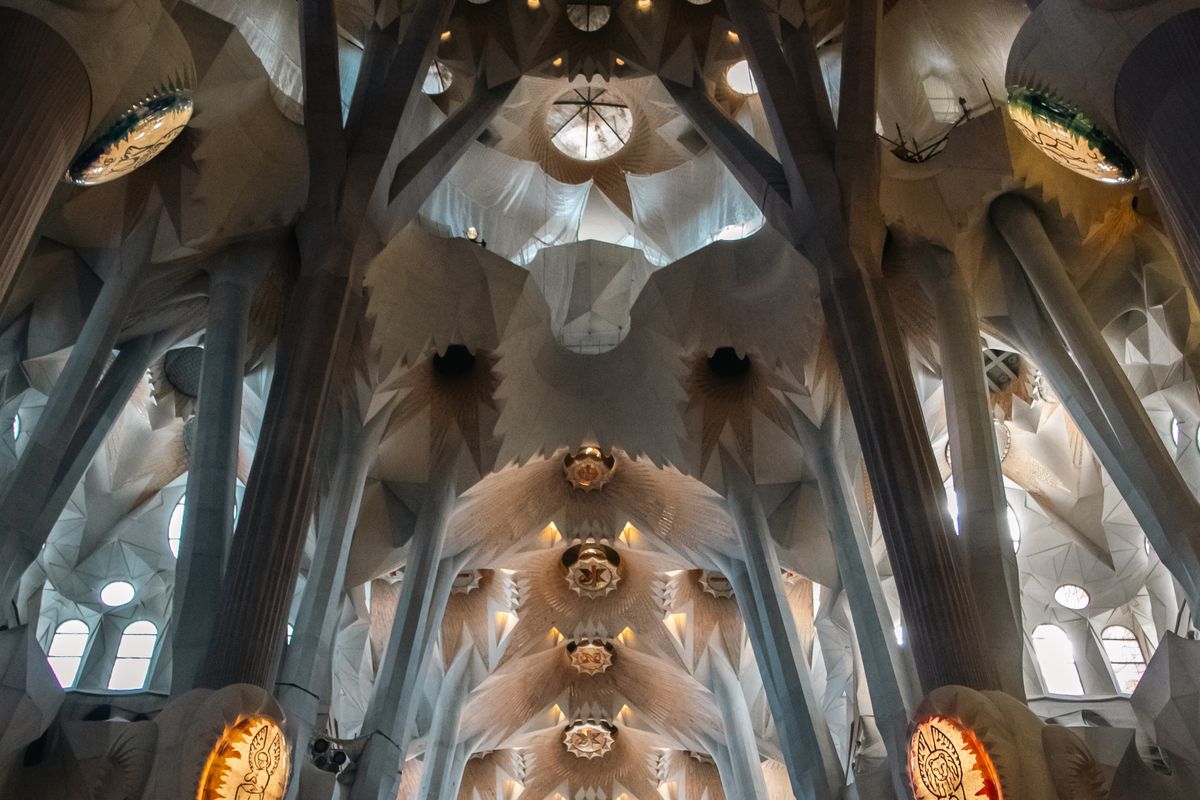
Here is the thing nobody quite prepares you for. From outside, the Sagrada Família is impressive and a little overwhelming, a great melting candle of a building. Inside, it does something else entirely. Gaudí built the nave as a forest: branching columns that split as they rise, leaning slightly, holding the roof up the way a tree holds its canopy. Stand under it and the ceiling reads as light filtering through leaves.
And then the glass. The windows are tuned by direction. The east side, facing the morning, runs cool — blues and greens that pour across the floor early in the day. The west side, facing the afternoon, burns hot: reds, oranges, golds. The whole interior shifts colour as the sun moves, and the effect is genuinely hard to describe to someone who hasn't stood in it.
Time your slot for the colour you want. Morning for the cool blues spilling east, late afternoon for the reds going molten on the west wall. Midday is the weakest light of the day in here — flat, white, and a waste of the one thing you paid for.
Plan on an hour and a half to two hours inside if you're not rushing, longer with the audio guide. There is a small museum below with Gaudí's original models and the upside-down chain rigs he used to work out the geometry — worth ten minutes, easy to skip.
Two facades, and the argument they start
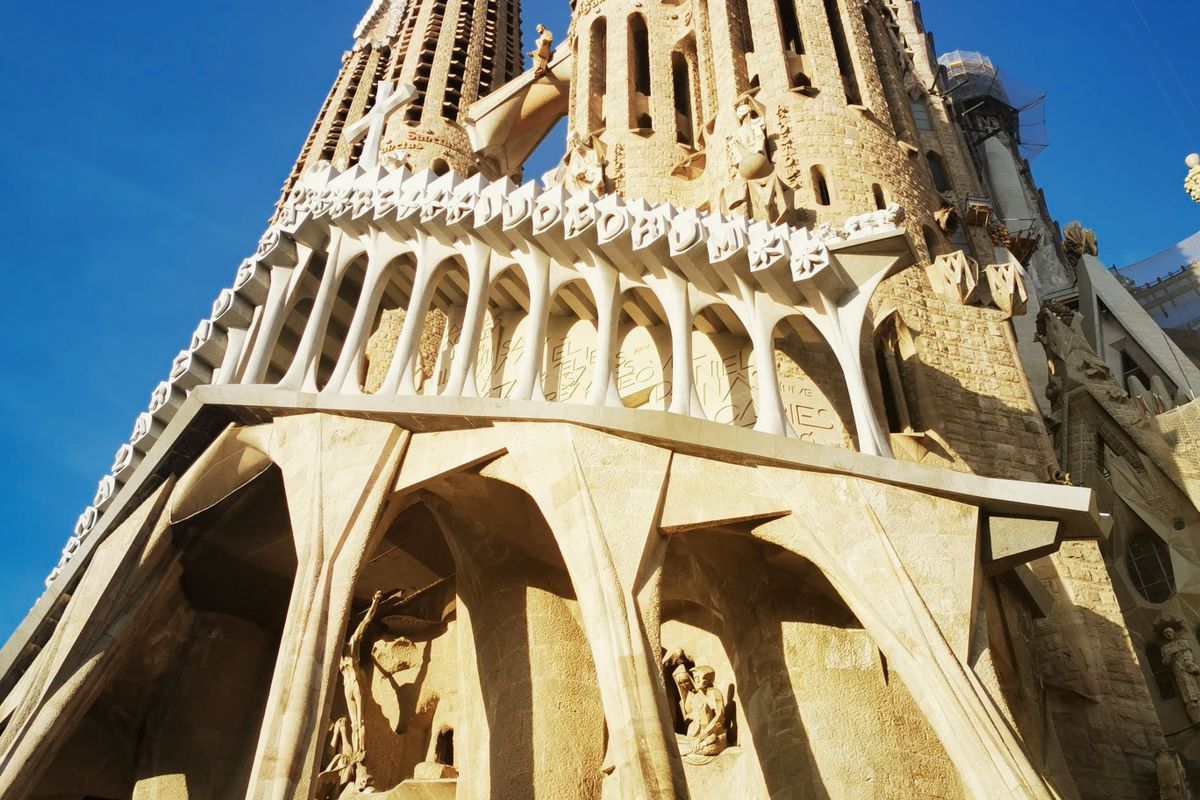
The outside is really two buildings stitched to one. The Nativity Façade on the east is Gaudí's own, finished in his lifetime — dense, organic, dripping with carved plants and animals and the chaos of growing things. It looks grown rather than built.
The Passion Façade on the west is the opposite, and on purpose. Sculpted by Josep Maria Subirachs through the late twentieth century, it is gaunt, angular, deliberately harsh — leaning columns like bones, faces cut down to planes. People fall out over it. Purists think it betrays Gaudí; others think a façade about suffering and death has no business being pretty. I'm in the second camp, but stand in front of both and decide for yourself — that's half the point of going. The building has carried a UNESCO World Heritage listing since the Nativity Façade and crypt were inscribed, which tells you the argument was settled long ago in Gaudí's favour.
A few things worth knowing before you go:
- Getting there: the basilica sits in the Eixample, on metro lines L2 and L5 (the Sagrada Família stop puts you at the door).
- The classic photo: the reflection in the pond at Plaça de Gaudí, the park on the Nativity side, gives you the towers mirrored in water. Early morning, before the crowds, before the harsh sun.
- When to go: first slot of the day or the last couple of hours before close. The middle of the day is the most crowded and the worst light.
- What's still happening: expect scaffolding somewhere on the exterior. It has been there for over a century; it is not going to spoil the visit.
If you're shaping a day around it, the other Gaudí sites pair naturally — Park Güell up on the hill for the mosaics and the city view, and Casa Batlló and La Pedrera down on Passeig de Gràcia if you want his domestic, dragon-bone architecture in a single afternoon.
So is it worth it?
Honestly: yes, with a condition. It's crowded, it's not cheap, and the marketing oversells the outside. But the interior is one of the few buildings that does something no photograph manages, and the light through that glass is the reason to pay. Book ahead, pick your slot for the colour, give the towers a miss unless you've got money and a head for heights to spare.
The one case where I'd hold onto your cash: if you only plan to see the exterior. From the street it's free, and a free look is plenty. The €26 buys you the inside, and the inside is the whole argument. For getting across town between sights, the metro and a sensible pair of shoes will do more than any tour package.